NatalPass · Journal

Foundations · Astrocartography

Astrocartography Explained: Maybe It's Not You — Maybe It's the Place


You Know That Feeling.

You step off the plane or walk out of the train station, and something in your body already knows. Sometimes your chest loosens. Your nervous system settles. You feel strangely… at ease, even if you've never been in this city before. Other times it's the opposite. Your shoulders tighten almost immediately. Simple things feel harder than they should. The city looks fine on paper, but your body is quietly saying no.

For years, many of us tried to override that feeling. We told ourselves we just needed to give it more time, be more adaptable, or "think positively." But what if the place itself is simply not a good match for your energy?

This is the question astrocartography helps you answer.

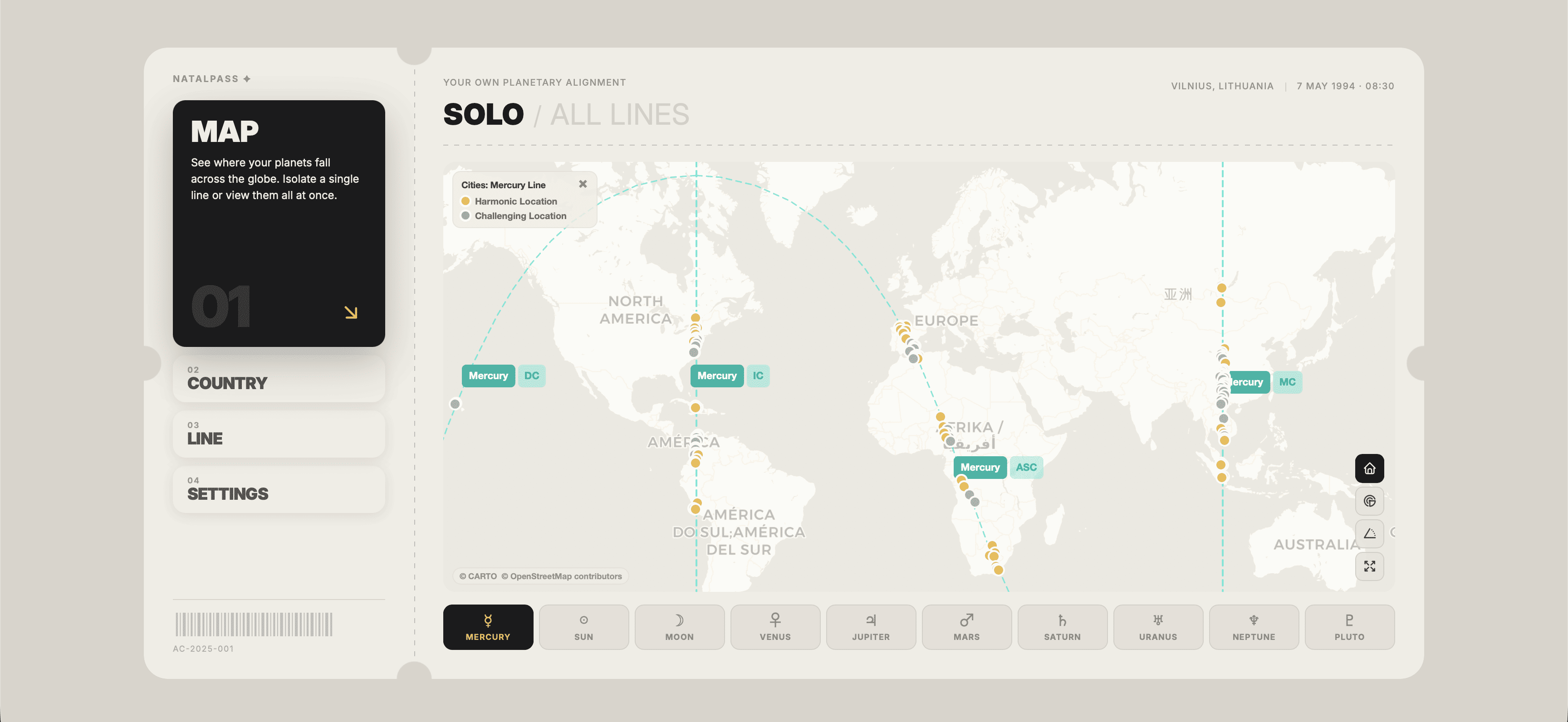
NatalPass map showing a Mercury planetary line and its harmonic and challenging cities around the world
Your natal chart, stretched across the globe — here, Mercury's line crossing harmonic and challenging cities.

What Astrocartography Actually Is

Astrocartography takes the exact positions of the planets at the moment you were born and projects them onto a map of the world. The result is a personal map covered in lines — each one showing where a specific planetary energy becomes stronger for you.

It doesn't tell you where you're "supposed" to live. It doesn't predict your future. What it does is show you where different parts of your personality and potential are likely to be amplified — sometimes beautifully, sometimes challengingly.

In simple terms: it helps you understand why some places bring out the best in you, while others seem to quietly work against you.

Why This Tool Feels So Personal

Because it names something most of us have already felt but couldn't explain.

Simone lived for three years in a city that everyone around her loved. It was safe, beautiful, full of culture. On paper, it was ideal. But she felt strangely flat the entire time she was there. She kept thinking something was wrong with her — maybe she wasn't trying hard enough, maybe she was just going through a phase.

When she finally looked at her astrocartography map, she saw that the city sat near several tense aspects to her Sun and Moon. Nothing catastrophic, but enough quiet friction to make her feel invisible and emotionally disconnected.

Later she moved to a place that aligned much more closely with her Venus and Jupiter lines. Within a few months, she noticed that people approached her more warmly, creative opportunities started appearing without her forcing them, and she finally stopped feeling like she had to perform just to feel okay in her own life.

This doesn't mean every city on a "good" line will be perfect. But it does mean that some places naturally support certain parts of you more than others — and once you see the pattern, you stop taking it so personally when a place doesn't feel right.

The Main Things You Need to Understand

Planetary Lines. Each planet creates a line across your map. The closer you live to that line, the more strongly that planet's energy shows up in your daily life.

The Four Angles. Every line crosses your chart at one of four key points, and each one changes where the energy appears:

  • ASC (Rising) — how you show up and how others experience you
  • MC (Midheaven) — your career, visibility, and public life
  • DC (Descendant) — relationships and the people you attract
  • IC — home, emotional safety, and your private inner world

The same planet on different angles can feel completely different. Venus on the MC might affect how you're received professionally, while Venus on the IC might change how at home you feel in your actual living space.

If you want to go deeper into what each planetary line actually feels like — with real examples, the gifts, the challenges, and how they play out across all four angles — check out our full guide: Astrocartography Planetary Lines Guide.

Aspects. These are the relationships between planets. A harmonious aspect can make a city feel supportive even if you're not directly on a line. A tense aspect can add friction to an otherwise good line. If you want to understand how lines and aspects interact in real life, read Aspects vs. Exact Lines in Astrocartography.

Distance (Orb). You don't need to live exactly on a line. The influence fades gradually with distance. As a general rule, the strongest effect is usually felt within about 100 km, still noticeable up to around 200 km, and becomes quite faint beyond that. For a clear, practical breakdown of how distance actually works, see How Close Do You Need to Be to an Astrocartography Line?

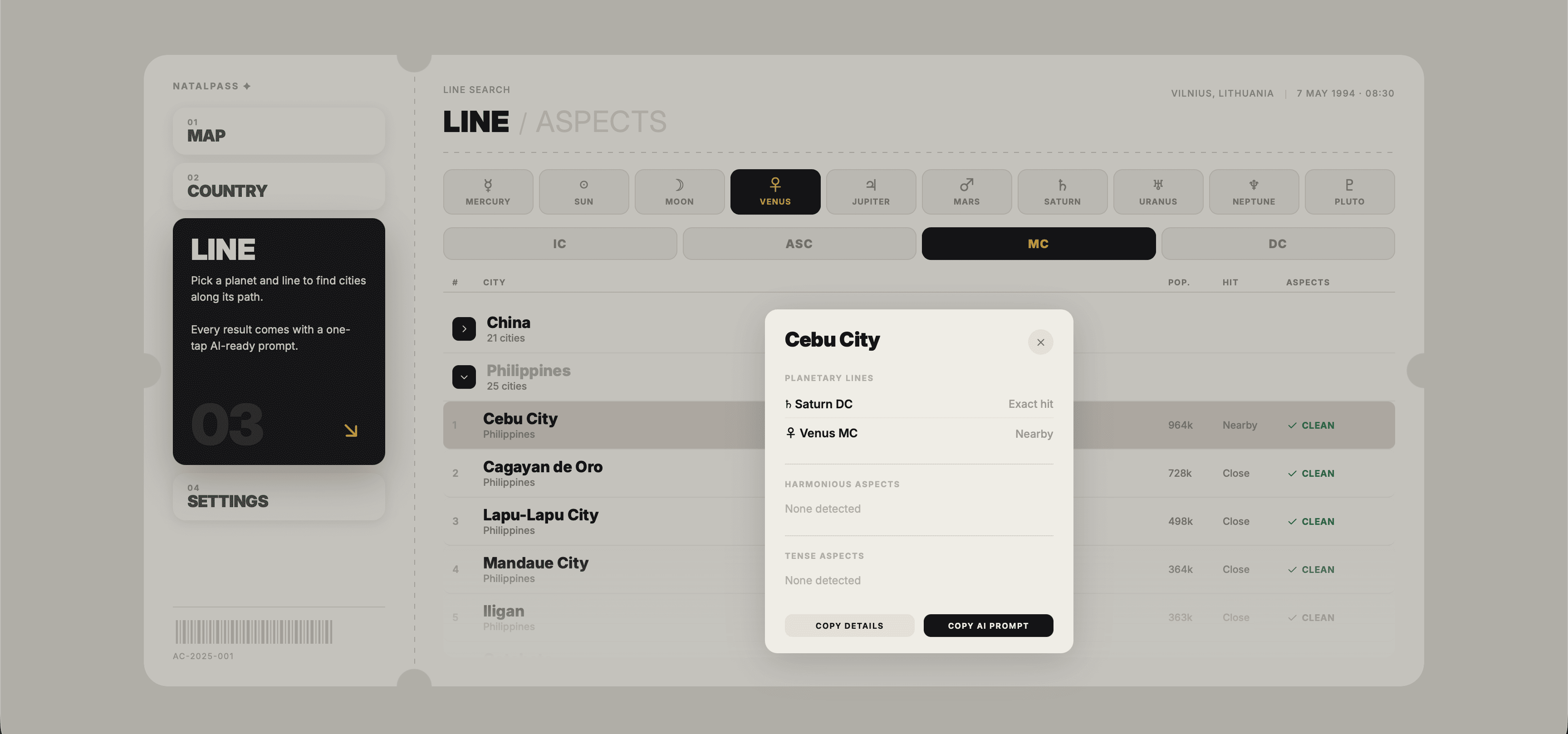
NatalPass city card for Cebu City showing a Venus MC line, aspect readings, and a one-tap AI-ready prompt button
Each city comes with its planetary lines, nearby aspects, and a one-tap AI-ready prompt.

What Each Planetary Line Tends to Bring

Here's a quick overview of what different planets usually highlight when their energy is strong in a location:

  • Sun Line — Feeling visible, confident, and connected to your purpose
  • Moon Line — Emotional safety, belonging, and the sense of being at home
  • Mercury Line — Mental clarity, communication, and learning
  • Venus Line — Beauty, ease, pleasure, and connection
  • Mars Line — Drive, courage, and forward momentum
  • Jupiter Line — Growth, opportunity, and expansion
  • Saturn Line — Structure, discipline, and building something real
  • Uranus Line — Freedom, reinvention, and breaking old patterns
  • Neptune Line — Inspiration, sensitivity, and deeper meaning
  • Pluto Line — Depth, transformation, and personal power

Each planet has its gifts and its challenges. If you want to go deeper into any of them, including how they play out across all four angles, you can explore the full guides linked above, one planet at a time.

Who This Tool Is Especially Useful For

Astrocartography tends to resonate most with women who:

  • Feel like they've outgrown their current city, but can't fully explain why
  • Have moved before and noticed that some places brought out the best in them while others quietly drained them
  • Are considering a move (or even a long stay) and want more than just practical information like rent and job opportunities
  • Keep thinking about certain cities and wonder if there's a deeper reason

If you've ever had the thought "this place should feel better than it does," astrocartography can help you understand why — without making it mean something is wrong with you.

How to Actually Start (Without Overwhelming Yourself)

You don't need to make any big decisions right away. The most useful first step is simply seeing your own map.

On NatalPass, you can generate your full astrocartography map in just a few minutes. Once you have it, here's how most people explore:

  1. Look at the lines that naturally draw your attention.
  2. Click on any city that interests you (either on the map or in the search results).
  3. In the city card, you'll immediately see which lines and aspects are active there — both supportive and challenging — with clear distance labels.
  4. Use the "Copy AI Prompt" button. It automatically combines that city's full planetary information with your personal natal chart into one ready-made prompt.
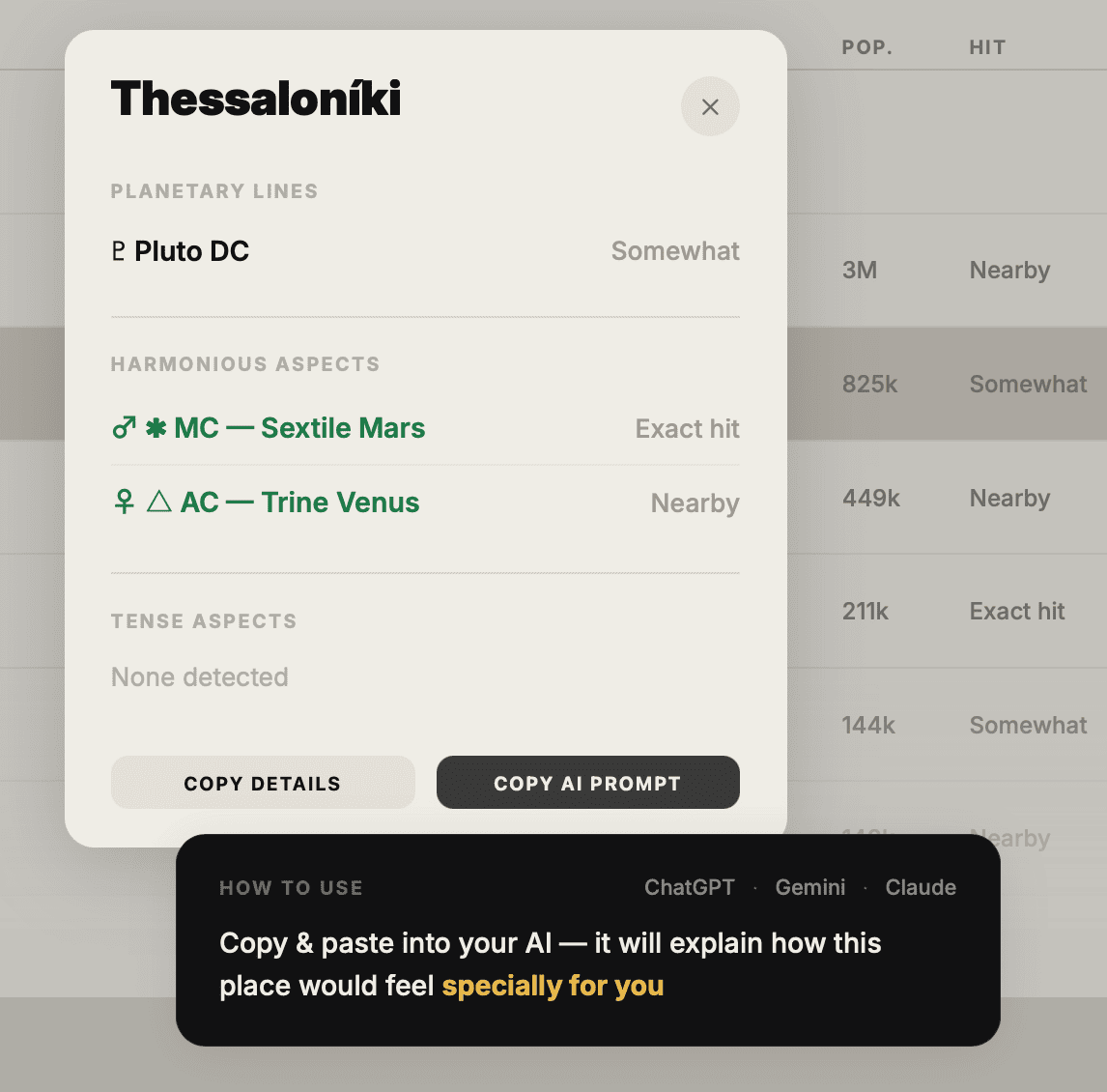
Close-up of a NatalPass city card for Thessaloníki showing a Pluto DC line, harmonious aspects, and the Copy AI Prompt button
Every city card ends the same way — one tap builds a prompt combining that place with your own natal chart.

You can then paste this prompt into any AI and get a detailed, personalized interpretation of how that specific place might actually feel for you.

This gives you a much clearer picture without doing all the work by hand. If you want the complete walkthrough — including exactly what to paste into AI and what to ask — read How to Talk to AI About Your Astrocartography Map.

Ready to See Your Own Map?

If you already have your birth time, you can generate your personalized astrocartography map right here on NatalPass.

Once you see your lines, the world often starts to make a different kind of sense. Some places will feel like they're quietly cheering you on. Others will feel like they're asking you to become someone you're not. Both are valuable information.

Astrocartography won't choose your life for you. But it can help you stop choosing places that quietly work against you — and start noticing the ones that might finally work with you.

From Theory to Your Own Map: a 5-Minute Video Guide

Now that you understand how astrocartography works, it's time to see your own lines drawn across a real map. We've put together a quick 5-minute video guide on how to use NatalPass to analyze your personal chart, filter for the best cities, and get AI-powered insights for your next move. Watch the full tutorial below:

  • 00:00What is astrocartography and why location matters
  • 00:37Venus vs Saturn lines: real-life examples
  • 01:00How to create your map on NatalPass (step-by-step)
  • 01:52How to read planetary lines on the map
  • 02:15Using the Copy AI Prompt for personalized readings
  • 02:47Country Mode: find lines in any country
  • 03:03Remove Tense Near: filter out difficult cities
  • 03:18Line Mode: search cities by a specific planetary line
  • 03:47How to use AI (ChatGPT, Claude, Gemini) with your map
  • 04:01Free features vs paid plan explained
  • 04:21Useful map controls (cities, influence zones, fullscreen)

Ready to start? Create your free map at NatalPass.com.

FAQ: Astrocartography for Beginners

What is astrocartography?

It's a branch of astrology that takes the exact positions of the planets at your birth and maps them onto the Earth. The result is a personal world map showing where each planet's themes — love, career, home, confidence, transformation, etc. — tend to become stronger for you.

Do I need my exact birth time?

Ideally, yes. The more precise your birth time, the more accurate your lines and angles will be. Even a difference of a few minutes can shift where a line falls. If you don't know your exact time, some general insights are still possible, but the angle-based interpretations (ASC, MC, DC, IC) will be less precise.

Is astrocartography scientifically proven?

No. It's not an empirically tested science. It's best approached as a reflective and intuitive tool — something that helps you notice patterns and ask better questions about place and energy, rather than a guarantee of specific outcomes.

How is astrocartography different from a regular birth chart or horoscope?

A regular natal chart describes who you are. Astrocartography takes that same chart and spreads it across the world, showing where different parts of you are likely to feel amplified, supported, or challenged depending on your location.

Can astrocartography tell me exactly where to live?

No, and that's actually a good thing. It won't hand you one "perfect" city. Instead, it shows you tendencies and energetic themes for different places, which you can then weigh against your real life — your values, relationships, finances, visas, and intuition. It's a powerful starting point, not a verdict.

What if I can't move right now — is this still useful?

Absolutely. Many women use it simply to understand why certain past places felt easy or difficult, to plan future trips, or to explore their map out of curiosity long before any relocation is realistic. The insights often help even without moving.

What's the difference between a planetary line and an aspect?

A planetary line shows where a planet was at a specific powerful angle (rising, setting, etc.) at your birth — the strongest, most direct signal. An aspect shows a relationship between two planets that becomes active in a location, even if no exact line is there. For a deeper dive, see Aspects vs. Exact Lines in Astrocartography.

How do I generate my own astrocartography map?

Just enter your birth date, exact time, and birthplace on NatalPass. Your full personalized map appears immediately — with every planetary line, angle, and aspect clearly labeled, plus city cards and the one-tap "Copy AI Prompt" feature to get personalized interpretations.