You've Found It. Then You Notice Two More Sections.
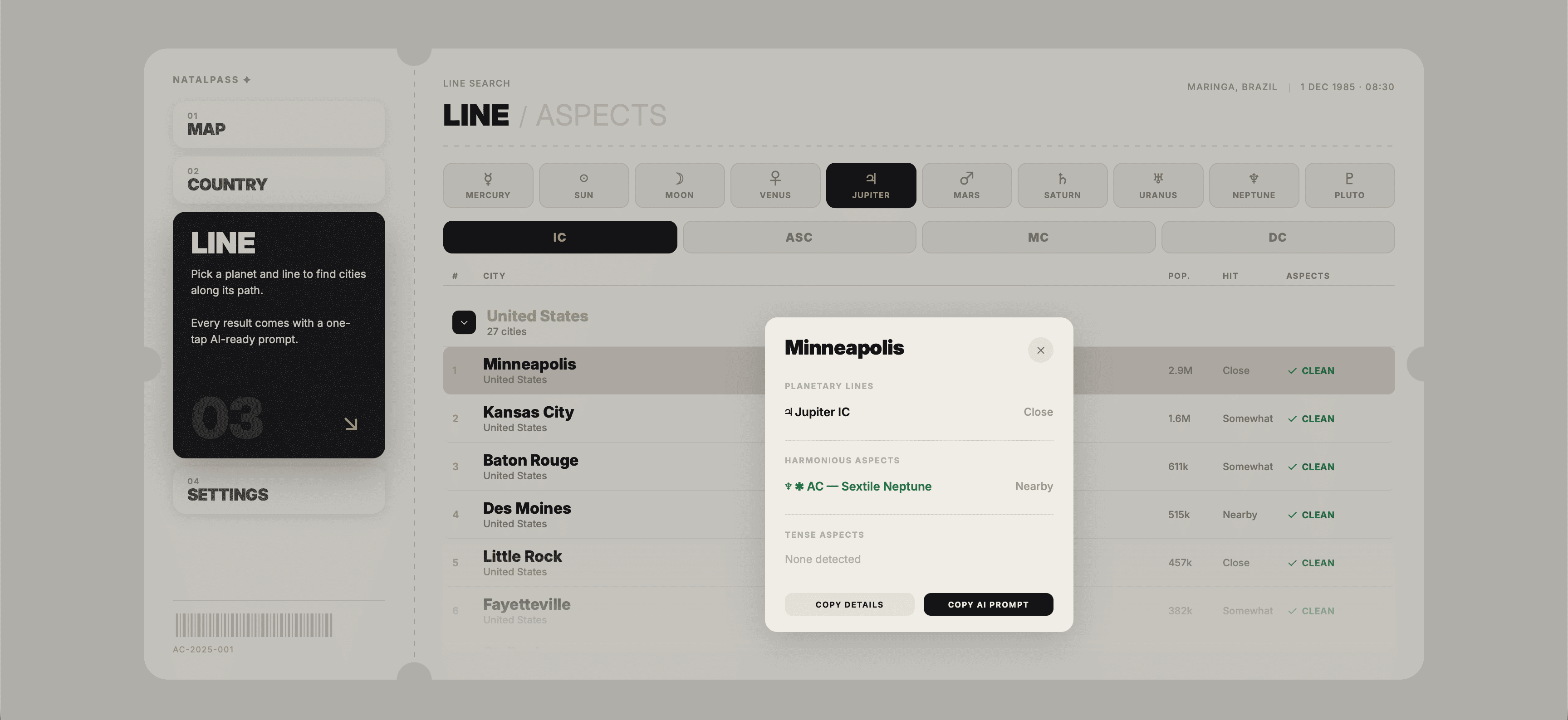
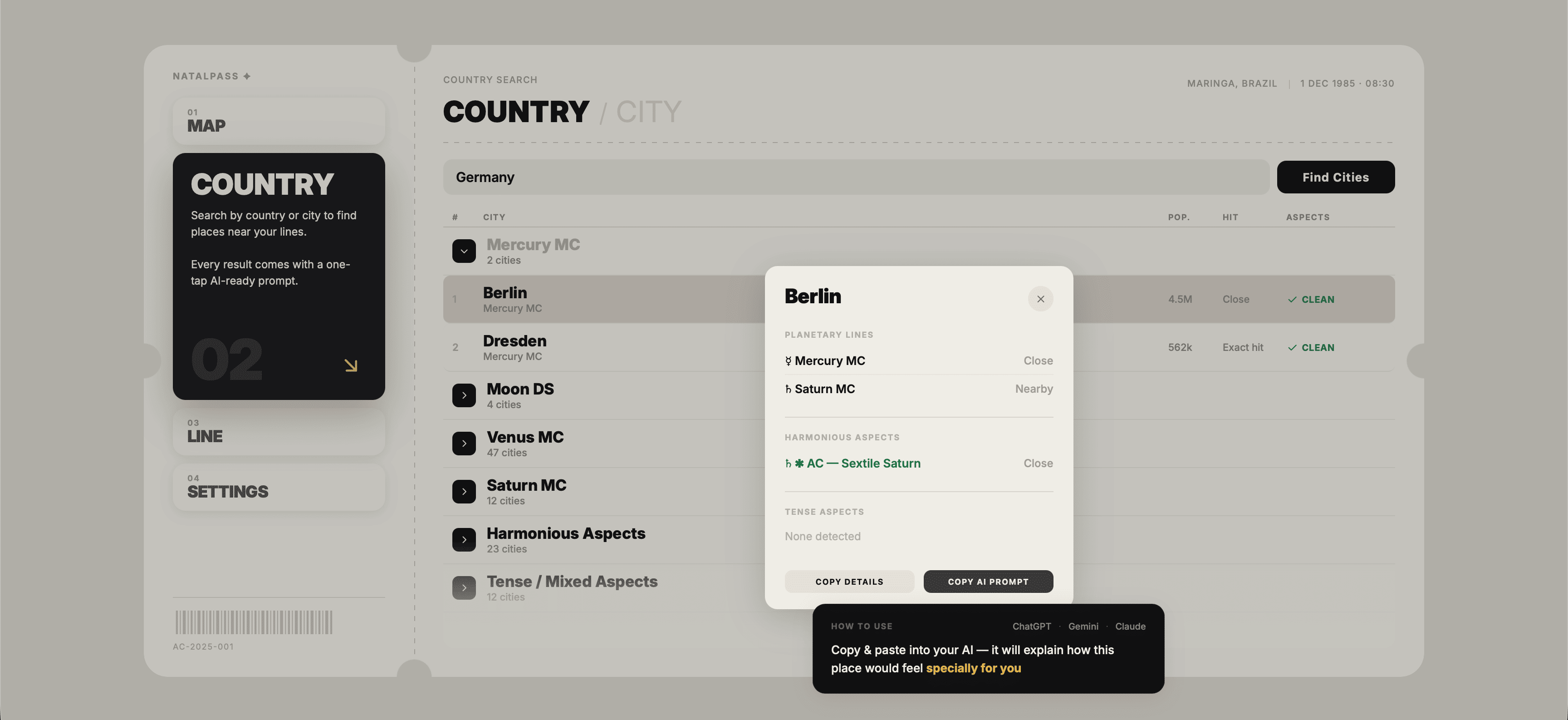
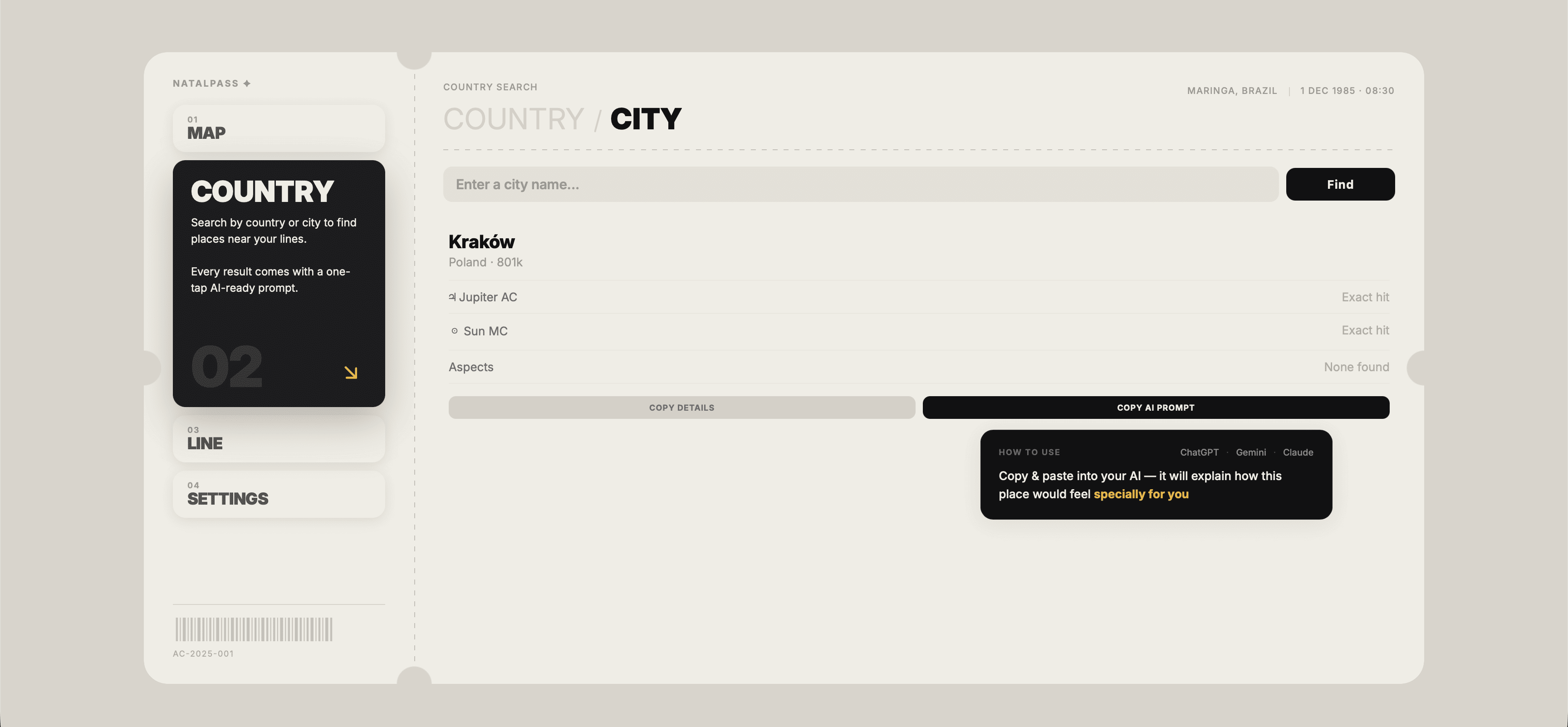
You've found it. Your Venus line, running right through the city you've been dreaming about for months. Your heart does a little jump — it feels like confirmation, like the map is finally agreeing with that quiet inner knowing you've carried for so long. You open NatalPass and click on the city, and its full card appears. Underneath the exact line you were so excited about, you notice two more sections: harmonious aspects, and tense ones.
If that moment has ever left you more confused than excited, please know you're not alone. Most of us have been there — falling for a beautiful line, only to feel a small hesitation once we see the fuller picture underneath it.
Aspects are probably the most under-explained part of astrocartography. They can feel abstract at first, and the map itself shows exact lines by default, so it's easy to miss that aspects exist at all until you open a city and see them listed. But once you understand them, everything else about reading a map starts to click into place. So let's slow down and talk through what they actually mean, in a way that's actually useful.
The Line Is the Headline. The Aspect Is the Full Story.
An exact planetary line is the clearest, strongest signal on your map. It marks the precise place where a planet was rising, setting, culminating, or at its lowest point at the moment you were born. Stand near that line, and you're stepping into the most concentrated version of that planet's energy available anywhere in the world.
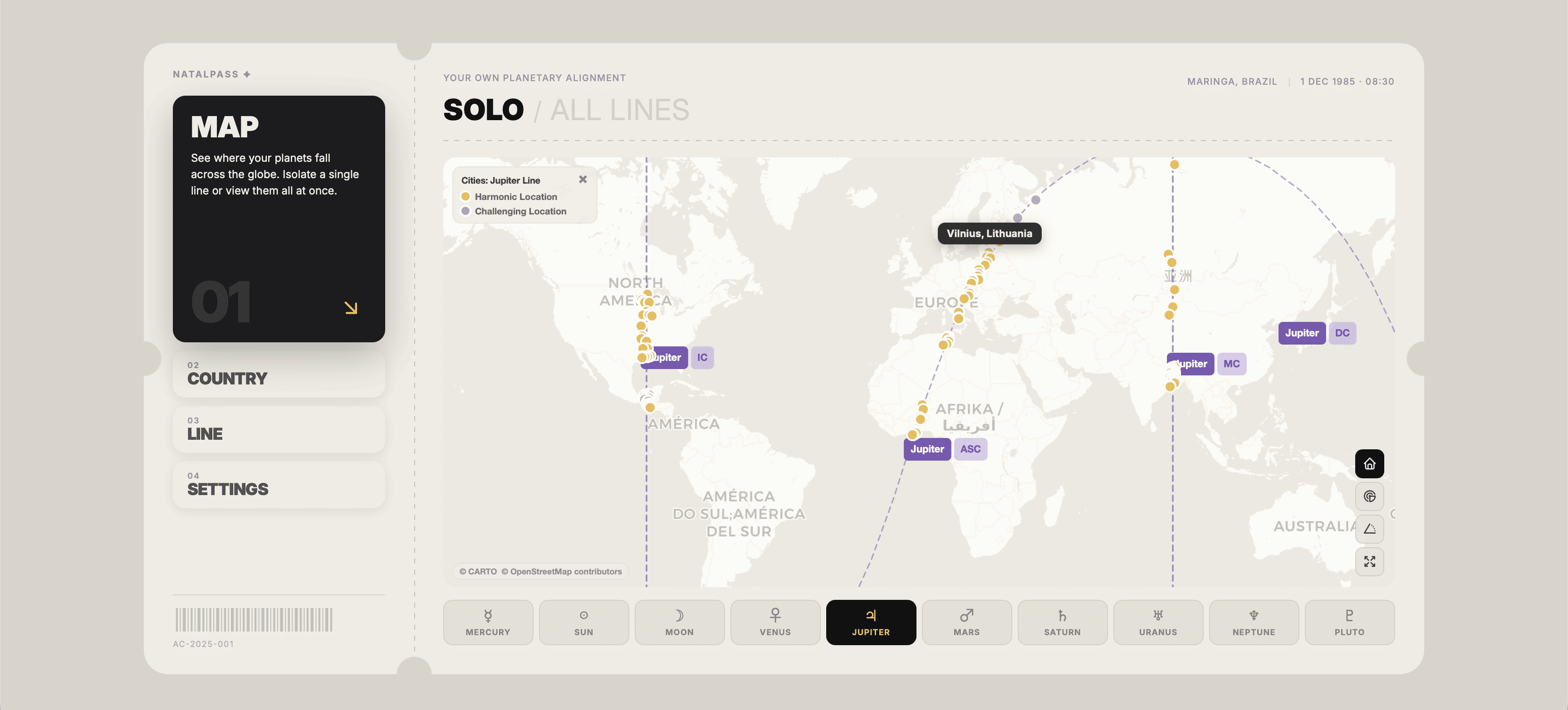
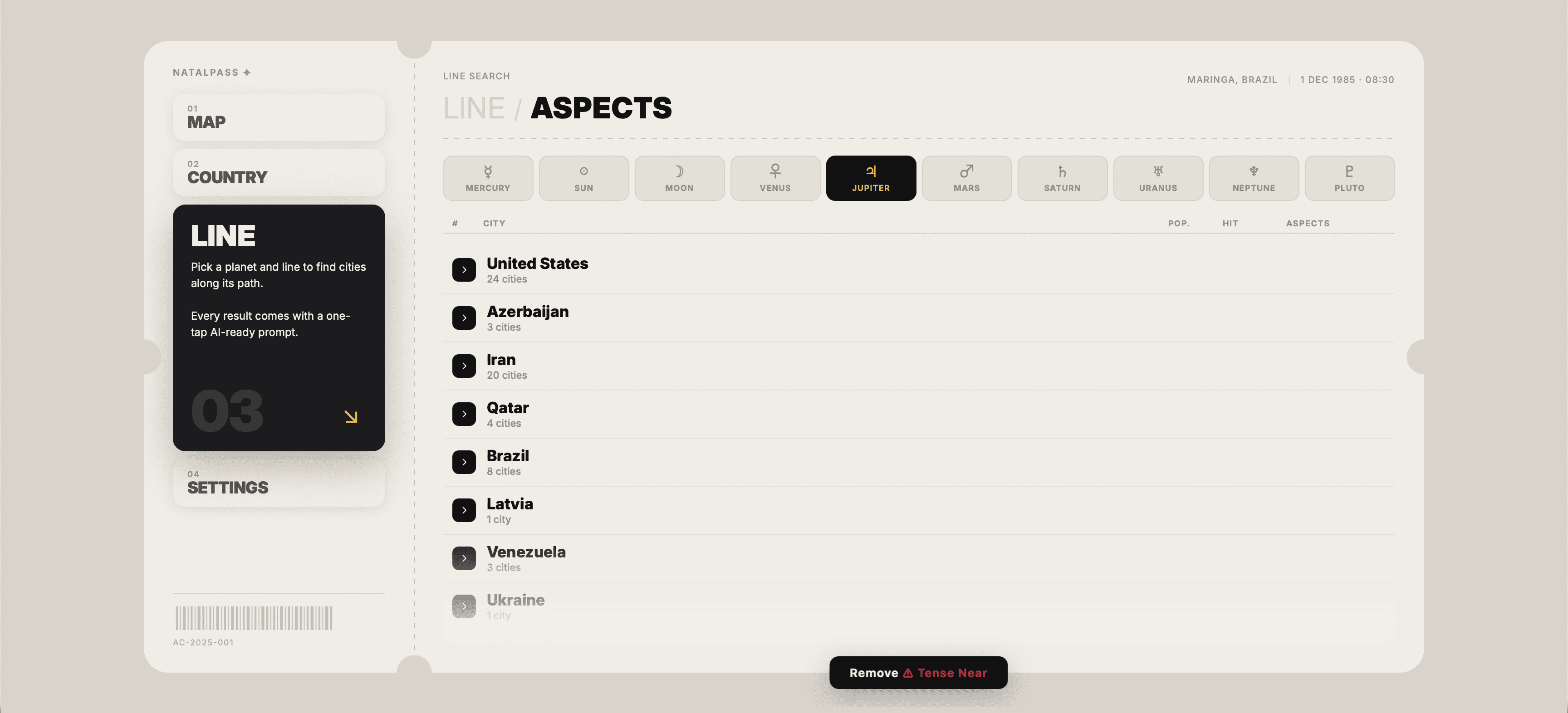
An aspect is something different. It's a relationship between two planets — the angle they form, measured from wherever you happen to be standing on the map. On NatalPass, when you open a city's card, these aspects are already sitting right there for you: which ones are harmonious, adding ease and flow, and which ones are tense, adding friction or challenge. You don't have to hunt for them or turn on any special layer to see them in a city card. They're part of the same view as the exact line. The map itself is a little different — it shows exact lines by default to keep things visually clean, and aspect lines only appear if you switch on that specific layer, since showing every possible aspect line at once would turn the map into a tangle nobody could actually read.
Here's the part that trips almost everyone up at first: a city doesn't need to sit exactly on a line to feel its influence. Aspects work with a zone of influence, called an orb, not a single precise point. That's exactly why a city sitting a comfortable distance from your Venus line can still feel remarkably soft and magnetic — a harmonious Venus aspect is quietly supporting it. And it's also why a city sitting right on a "dream" line can sometimes feel strangely heavy or complicated: a tense aspect from another planet may be adding an undertone you can feel but can't quite name. Wondering exactly how many kilometers that orb actually covers? Here's the practical breakdown: How Close Do You Need to Be to an Astrocartography Line?
Exact Lines: The Loudest, Clearest Signal
Think of your exact line as the main melody playing in a city. If Venus is exactly on your line there, themes of beauty, ease, connection, and pleasure tend to sit front and center. You usually notice it within the first few days — people respond to you differently, life feels a little softer, things flow with less effort than you're used to.
This is why exact lines get so much attention, and rightly so. They're the foundation, the clearest, most unmistakable version of a planet's energy you can find anywhere on your map. But "clearest" doesn't always mean "complete." A single line tells you one powerful, true thing about a place. It doesn't tell you the whole story.