NatalPass · Journal

Planetary Lines · Astrocartography

Moon Line Astrocartography: Home, Emotion, and the Deep Feeling of Finally Belonging


A Particular Kind of Tired

There's a particular kind of tired that has nothing to do with how much sleep you get.

It's the tired of living somewhere that never quite feels like yours — going through the motions in an apartment you've decorated twice, in a city you know like the back of your hand, and still lying awake some nights with the quiet, unshakeable feeling that you're a guest in your own life. You've told yourself it's just a phase. Maybe it's just you.

Maybe. Or maybe your body has been trying to tell you something your mind hasn't caught up to yet: that home isn't just where you happen to live. It's a feeling, and some places on the map are simply built to give it to you more easily than others. In astrocartography, that feeling has a name, and it belongs to the Moon.

The Moon as Emotional Safety

Of every planet in your chart, the Moon is the one that speaks in feelings instead of facts. It governs your emotional world — your need for comfort, your instincts, your memories, the parts of you that operate quietly under the surface long before your conscious mind catches up. Near your Moon line, all of that gets louder, gentler, and much harder to ignore.

This usually doesn't look dramatic. It looks like sleeping more deeply than you have in years. It looks like crying at something small and not quite knowing why, and feeling better afterward instead of embarrassed. Women who spend time on their Moon line often describe an emotional exhale they didn't know they'd been holding.

This is the planet of safety, not excitement. It won't hand you a thrilling story the way Jupiter or Pluto might. What it offers instead is quieter and, for a lot of women, far more necessary: the sense that somewhere out there, a version of "home" exists that doesn't require you to armor up first.
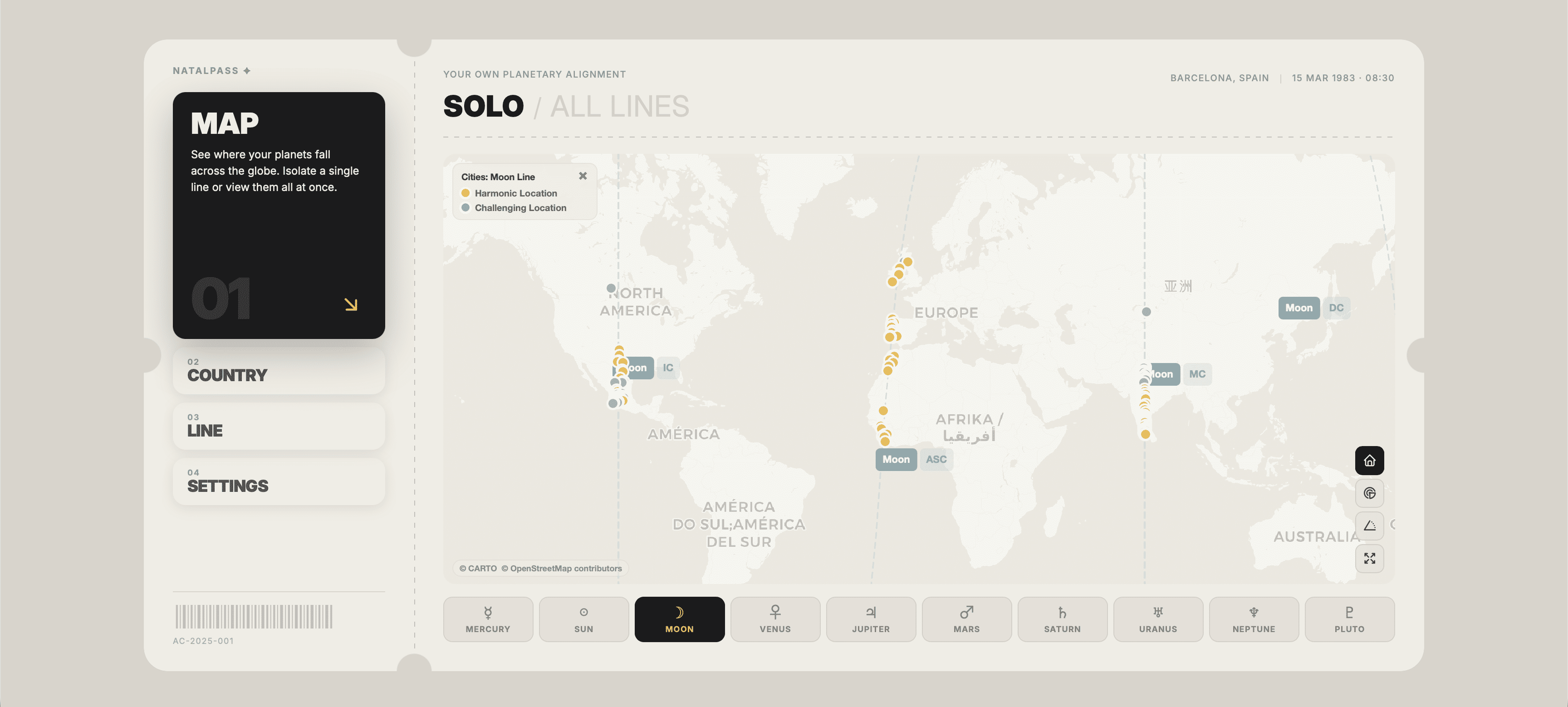
NatalPass map showing Moon ASC, MC, DC, and IC lines crossing the world
The Moon, every angle at once — the softest line on the map, wherever it falls.

Moon on the IC: The "Home Feeling," Literally

The IC is already the angle of home and roots in astrocartography. Put the Moon there, and you get the single most "home-like" placement on the entire map — Moon on the IC is the line people describe, again and again, as the closest thing to a forever address they've ever felt.

Delphine had moved six times in twelve years before she found her Moon IC city, and she still remembers the specific, almost embarrassing moment she knew something had shifted: standing in a rented kitchen, three days after arriving, making tea for no reason other than that it felt good to be there. "I wasn't trying to make it feel like home," she said. "It just did." Family patterns tend to soften here too, and daily routines start to feel restorative instead of just necessary.

This is the line most people mean when they ask, half-hopefully, "is there a city where I'd actually feel at home?" For a great many women, the honest answer is: probably somewhere near this one.

Moon on the DC: Relationships That Hold You

The Descendant governs partnership, and Moon on the DC changes the emotional texture of everyone you meet. Connections formed on this line tend to be nurturing rather than exciting — steadier, more attuned, built on the kind of quiet care that doesn't announce itself.

People on a Moon DC line often describe relationships that feel less like performance and more like being genuinely looked after. Friends who remember the small things. Partners who notice when something's wrong before you've said a word. Here, attachment tends to come more easily, and so, sometimes, does the risk of leaning on it a little too hard — which we'll come back to.

Moon on the MC: When Caretaking Becomes Your Calling

The Midheaven is your career and public reputation, and Moon on the MC means your work and your emotional world stop staying neatly separated. Careers touched by Moon MC often lean toward caretaking, healing, hospitality, or anything that asks you to hold other people's feelings alongside your own.

Naomi had spent years in a career that rewarded detachment, and she assumed that was simply how professional life worked. Her Moon MC city changed that assumption fast. "People kept telling me I was 'good with people,' like it was a soft skill instead of the actual skill," she said. "For the first time, being the person who noticed when someone was struggling wasn't a distraction from my job. It was the job." Recognition here rarely arrives loudly. It tends to arrive slowly, through trust.

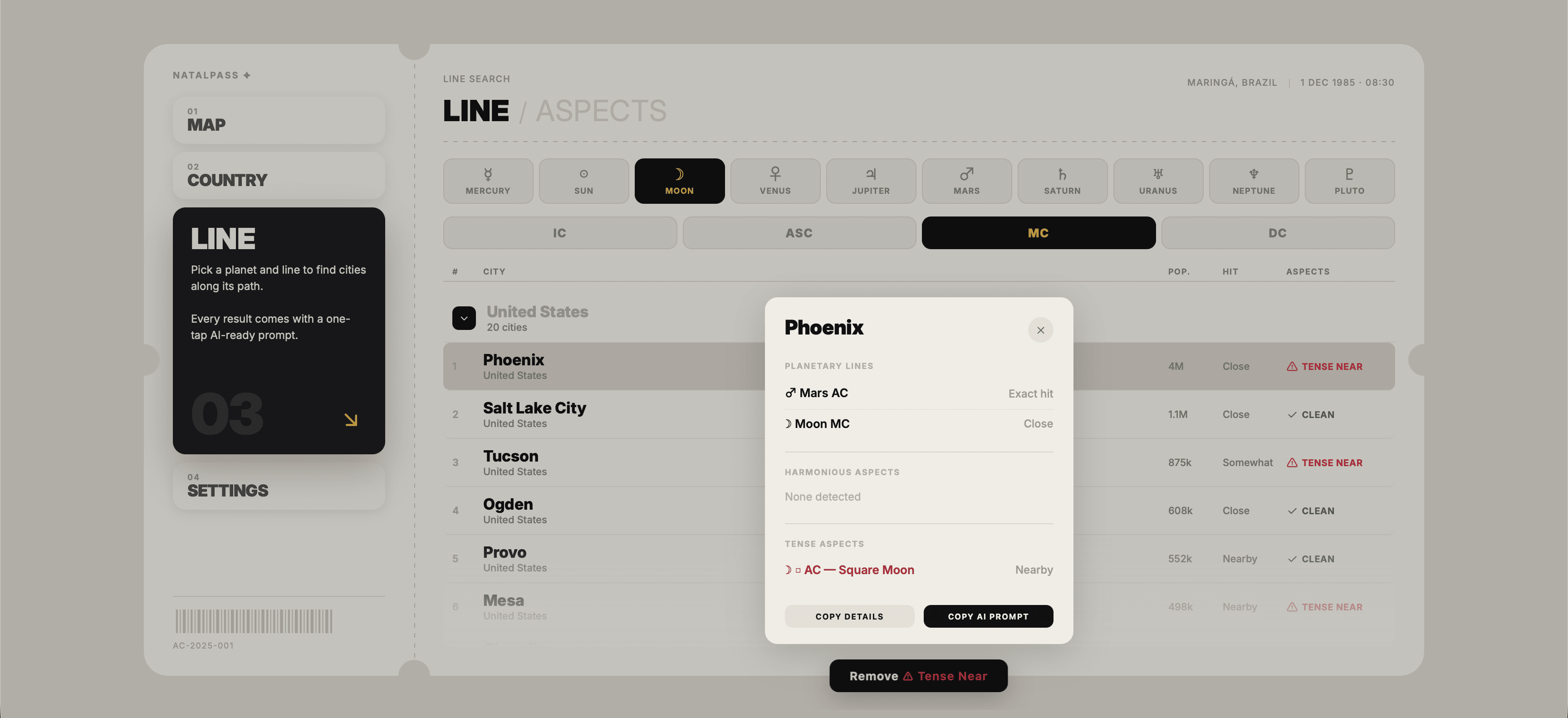
NatalPass city card for Phoenix showing a Moon MC line with a tense aspect nearby
A Moon MC hit on Phoenix, with a tense aspect nearby — worth reading against your own natal chart.

Moon on the ASC: Wearing Your Softness Openly

The Ascendant shapes your presence, and Moon on the ASC makes you more visibly emotional, more approachable, more instinctively read as safe by the people around you. Strangers tend to open up to you quickly on this line, sometimes surprisingly so.

Lucia noticed it within her first week in her Moon ASC city — the woman at the bakery telling her about her divorce, a stranger on a park bench asking for advice she hadn't offered to give. "People just started talking to me like they'd known me for years," she said. "Then I realized I'd spent so long being told I was 'too sensitive' that I'd forgotten sensitivity could be something people are drawn to, not something I needed to apologize for."

You don't have to guess where your own "home feeling" actually lives. On NatalPass, you can see your exact Moon line drawn across the map, filter to just this planet and angle, and check precisely which cities and countries it touches for you.

What This Line Is Genuinely Good For

A strong Moon line is one of the best possible placements for rest, healing, and rebuilding — the kind of quiet, unglamorous repair that doesn't happen overnight and doesn't photograph well, but that changes everything underneath. It's a wonderful line for reconnecting with family, for nesting into a home that finally feels worth decorating with intention, for recovering from a season of life that asked too much of you for too long.

If you're coming out of burnout, grief, a hard chapter, or simply years of living somewhere that never fit, a Moon-line city is often exactly the kind of soft landing you're looking for. This is not a line that pushes you to grow through discomfort. It's a line that lets you heal through comfort instead — which is its own, equally valid kind of medicine.

The Risks: Moodiness, Nostalgia, and Leaning Too Hard

Here's the part that deserves the same honesty we'd give any other line.

Because the Moon amplifies emotion so directly, moodiness tends to come along with the sensitivity. Feelings that used to stay manageable can surface more easily and more often. This isn't a malfunction. It's the same openness that makes this line so healing, just without the filter you're used to having.

Nostalgia is its other close companion. It can feel comforting at first — until you realize you're circling the past instead of moving forward. And then there's dependency, which shows up quietly and often in relationships. Because Moon lines make attachment come so easily, it's worth watching for the difference between real intimacy and simply needing someone else to hold your feelings for you. The comfort this line offers is real. It isn't a substitute for your own steadiness.

How to Know If Your Moon Line Is Grounding You or Just Familiar

This is the honest question worth sitting with before you fall in love with the idea of a Moon-line move: does this place make you feel more like yourself, or does it just feel like the past?

Grounding looks like rest that leaves you steadier, not smaller. It looks like emotional openness that actually moves through you instead of looping in place, relationships that nurture you and still let you grow, a home that restores you without becoming a hiding place from the rest of your life.

Regression looks different, even though it can feel remarkably similar at first. It looks like comfort you're using to avoid something — a decision, a conversation, a version of your life that's actually ready to expand. If your Moon line is quietly becoming a place to hide rather than a place to heal, that's worth noticing honestly, without judgment, before you build your whole life around it.

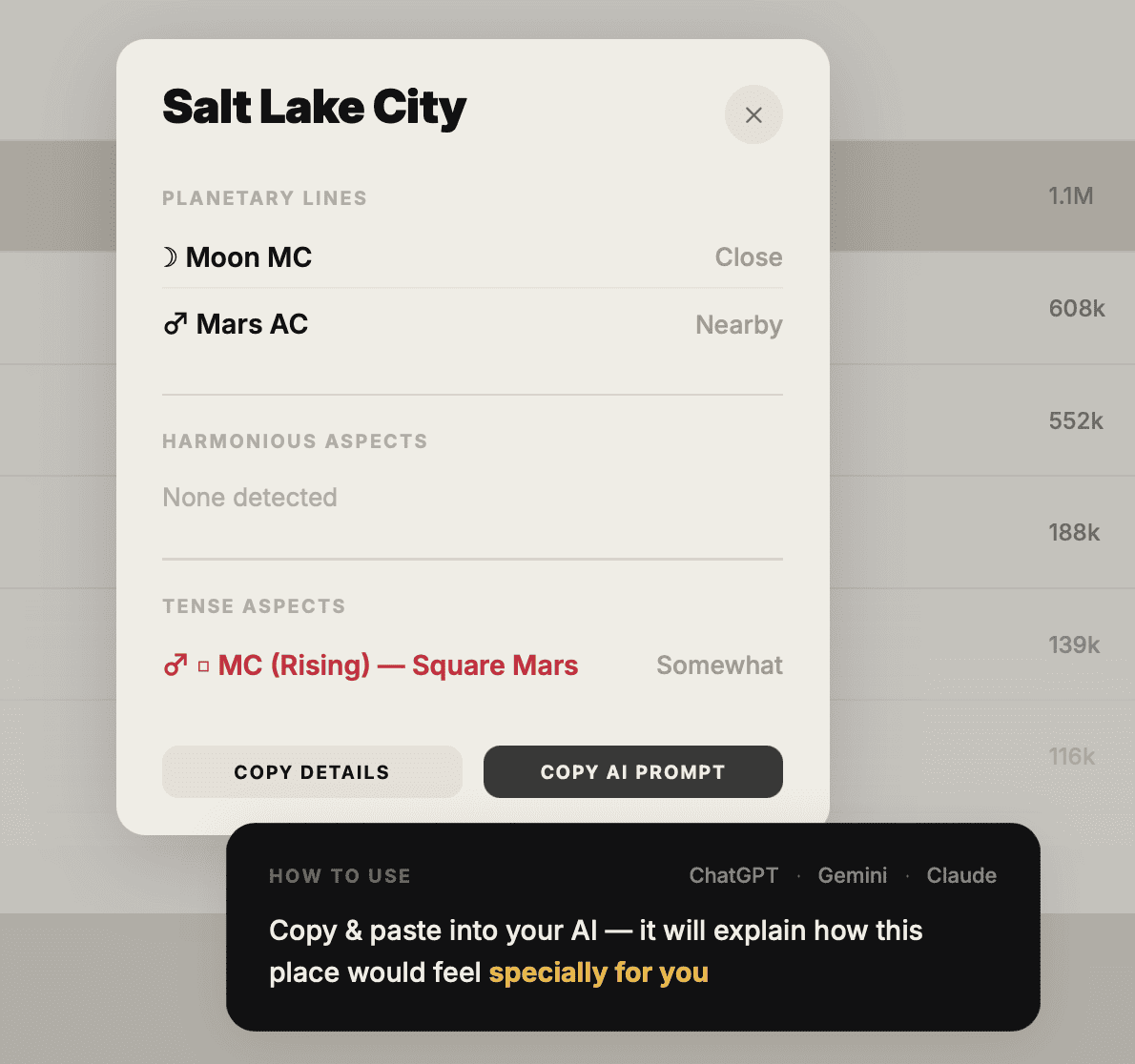
This is exactly where it helps to look at your Moon line alongside your full natal chart rather than in isolation. On NatalPass, you can open the city card for anywhere your Moon line runs and copy a ready-made AI prompt that blends that location's planetary picture with your own natal Moon — so you're reading your actual emotional patterns, not just a comforting feeling that might or might not be telling you the whole truth.

Close-up of the NatalPass Copy AI Prompt button for a Moon MC hit on Salt Lake City, with a tip to paste it into ChatGPT, Gemini, or Claude
One tap copies a prompt built from that city and your own natal chart — ready for ChatGPT, Gemini, or Claude.

A Gentler Way to Come Home

The Moon was never asking you to run from your life. It was asking you to finally stop pretending you didn't need somewhere soft to land.

If you've spent years being the strong one, the capable one, the one who makes everywhere work no matter how it actually feels — your Moon line might be the first place that doesn't ask that of you. Not because it fixes everything. Because, for once, it doesn't ask you to fix anything at all. It just asks you to rest, to feel what you feel, and to let that be enough — maybe for the first time in a long time.

FAQ: Moon Line Astrocartography

What does a Moon line do in astrocartography?

It marks places where emotional safety, comfort, and the feeling of "home" become easier to access. Rest comes more naturally, feelings surface more gently, and daily life tends to feel more nurturing and restorative than usual.

Is Moon IC the best line for feeling at home?

For most women, yes — it's consistently described as the most "home-like" placement on the map. It combines the IC's themes of roots and inner life with the Moon's deep emotional comfort. That said, "best" always depends on your full chart and what season of life you're in right now.

What does Moon DC mean for relationships?

Moon on the Descendant tends to attract nurturing, emotionally attuned people — partners and friends who notice how you're feeling and create a sense of being genuinely looked after. It's less about excitement and fireworks, and more about steady, caring connection.

Can a Moon line be too comfortable?

Yes, it can. The same comfort that makes this line healing can also make it easy to stay in familiar patterns instead of moving forward. Nostalgia and emotional safety sometimes blur into avoidance if you're not paying attention.

How do I know if my Moon line is healthy for me or just familiar?

Ask yourself whether the place leaves you feeling steadier and more like yourself over time, or whether it's quietly becoming a soft place to hide from decisions and growth you're actually ready for. True grounding restores you. Regression just distracts you from what's next.

Is a Moon line good for healing after a hard chapter?

Often, yes. It's one of the strongest lines for rest, emotional recovery, and gentle rebuilding after burnout, grief, or a difficult season. It supports comfort and safety rather than pushing you through more discomfort.

What's the difference between a Moon line and a Venus line?

The Moon is about deep emotional safety, home, and belonging — it speaks directly to your nervous system. Venus is about beauty, pleasure, romance, and social ease. Both can feel wonderful, but the Moon tends to feel more private and internal, while Venus feels more aesthetic and relational.

How do I find my personal Moon line cities?

The most accurate way is to generate your astrocartography map with your exact birth data. On NatalPass, your Moon line appears clearly on the map, showing exactly which countries and cities it passes through and on which angle — so you can see real, personal options instead of guessing.