NatalPass · Journal

Reading Your Map · Astrocartography

How Close Do You Need to Be to Feel an Astrocartography Line? A Practical Guide to Orbs and Distance


The Question Everyone Ends Up Asking With a Ruler in Hand

Quick answer: The influence of an exact planetary line is usually strongest within about 100 km, still clearly noticeable between 100–200 km, and generally becomes too faint to rely on beyond 200 km. Aspects have a slightly narrower range — most meaningful within roughly 100 km.

At some point, almost everyone who takes astrocartography seriously ends up doing the same slightly ridiculous thing: zooming way into the map, squinting at the tiny scale bar, and trying to figure out whether a city is 80 km or 180 km away from a line. Some people even open Google Maps in another tab to measure the exact distance. If that sounds familiar — welcome. You're in very good, and very tired, company.

This is one of the most practical and least romantic questions in all of astrocartography, and it deserves a genuinely practical answer instead of vague reassurance like "you'll just feel it." So let's actually answer it.

What "Orb" Means in Plain Language

In astrology, an orb is simply the margin of influence around an exact point. Nothing in astrocartography works like a sharp on/off switch. The energy fades gradually, the way warmth slowly disappears as you walk away from a fire — strongest right next to it, still noticeable a little further out, and eventually too faint to really register.

This principle applies to both exact planetary lines and aspect lines, but they don't fade at exactly the same rate.

Strongest Directly on the Line

There's no real debate about this part: the closer you are to an exact line, the stronger and more unmistakable its theme tends to feel. Standing directly on your Venus line gives you the most concentrated version of that energy available anywhere on your map. As you move away, the signal doesn't vanish, but it does soften, layer by layer, the further out you go.

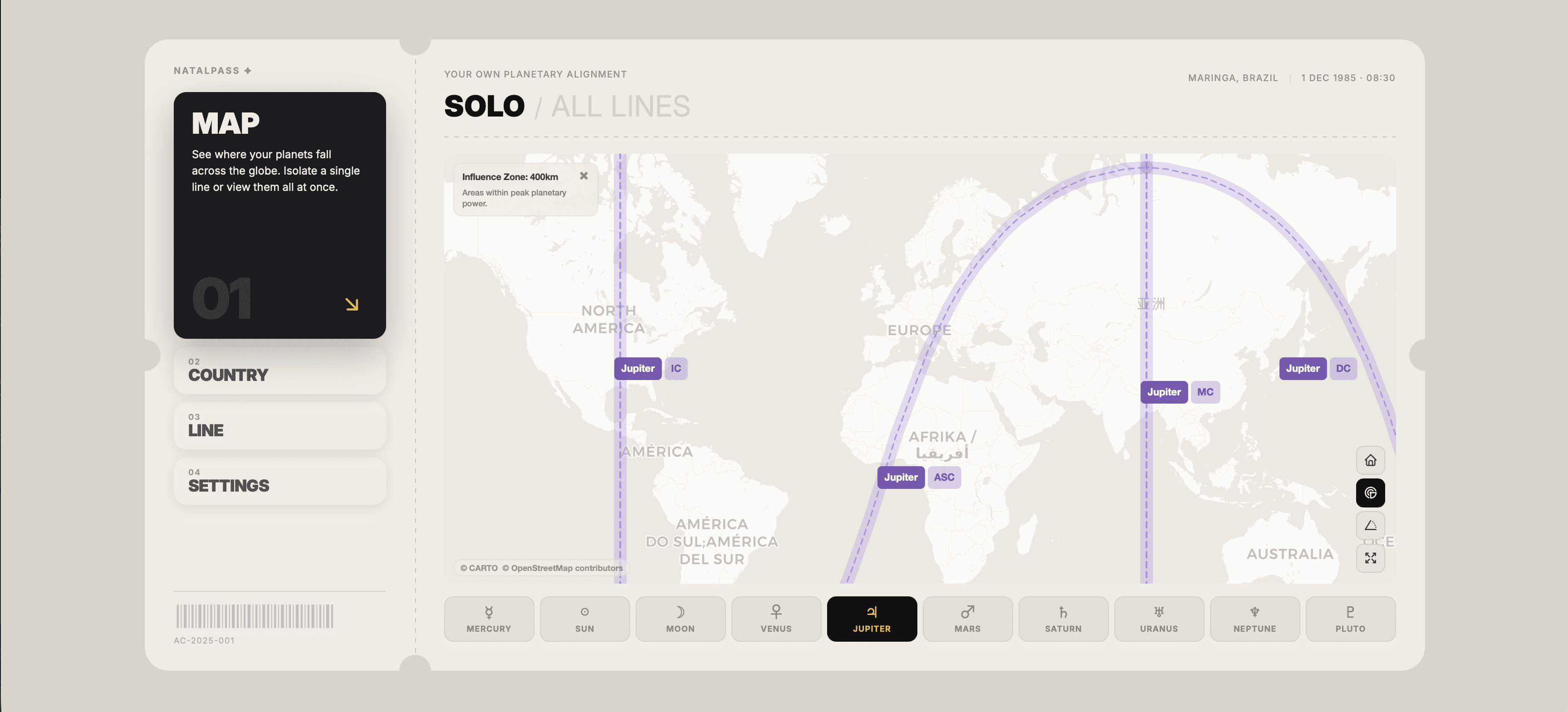
NatalPass map showing a Jupiter line with its 400km influence zone highlighted — 200km on each side
The "Planet Influence Width" layer: a 400km zone, 200km on either side of the exact line.

A Practical KM Guide (Because Nobody Wants Vague Reassurance)

Astrologers have different opinions on exactly how far a line's influence extends. Some traditional sources suggest very wide orbs (up to 700 miles / ~1100 km), while most modern practitioners prefer tighter, more practical ranges.

Here's a realistic, working guide that many people find useful in real life:

  • Within ~100 km of an exact planetary line → the effect is usually strong and hard to miss. This is where the planetary theme feels most concentrated and clear.
  • 100–200 km → the influence is still genuinely present, but softer and more subtle. You'll likely feel it, especially if you're sensitive to the energy, but it won't be as overwhelming.
  • Beyond 200 km → the exact line's influence generally becomes too faint to reliably plan your life or major moves around.

If you want to go deeper into how lines and aspects interact with each other, check out our full article: Aspects vs. Exact Lines in Astrocartography: Why the Quiet Influences Often Matter Most.

Aspect lines tend to have a slightly narrower range because they are already a secondary, more diffuse signal. They are most meaningful within roughly 100 km, and usually fade out beyond that.

There's one important exception worth remembering: when you're trying to avoid a tense aspect (rather than seeking a harmonious one), it's wiser to give yourself more space. Tense aspects can still create a faint but noticeable friction even a bit further out. Staying more than 200 km clear of a challenging aspect is often a safer practical buffer.

None of these numbers are absolute laws of physics. They are practical guidelines based on experience. Your own sensitivity, your natal chart, and the specific combination of energies in a city will always have the final say. But these ranges give you a solid starting point instead of guessing blindly.

This is exactly why NatalPass doesn't make you do any of this math yourself. Every line and aspect is already sorted into a clear distance category, so you can skip the ruler entirely.
You Don't Actually Need to Calculate Any of This

Here's the good news: you don't have to memorize any of these kilometer ranges or do manual calculations every time you look at a city.

On NatalPass, we've already done the work for you. Every line and aspect near a city is clearly labeled with one of four simple, easy-to-understand categories:

  • Direct Hit — right on or extremely close to the line (strongest influence)
  • Close — within the strong, noticeable range
  • Nearby — still within a meaningful but softer zone of influence
  • Somewhat — further out, where the effect becomes quite subtle

These categories are based on the practical distance ranges we discussed above, combined with real user feedback. So instead of zooming in, measuring distances, and second-guessing yourself, you can simply look at the label and immediately understand how strong that particular influence is likely to be in that city.

This is one of the biggest time-savers on the platform — and one of the reasons many people say using NatalPass feels so much lighter and more enjoyable than doing everything manually.

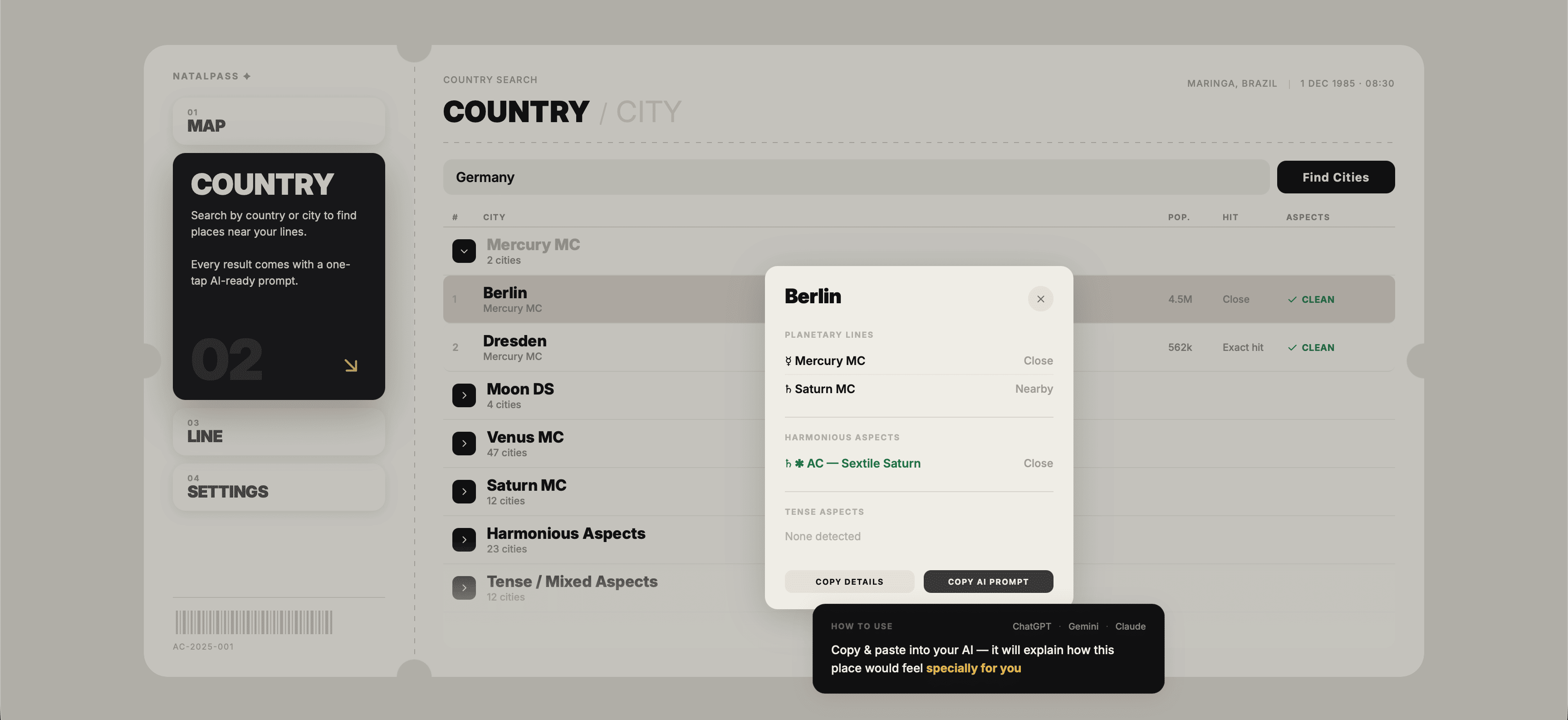
NatalPass country search for Germany showing a Berlin city card with Close and Nearby distance labels
No ruler needed — every line and aspect near a city already comes labeled Direct Hit, Close, Nearby, or Somewhat.

The Real Danger Is Tense Aspects — and This Is the Part Worth Being Careful About

If there's one thing in astrocartography that truly deserves your attention and caution, it's not being too far from a line you want. It's being too close to a tense aspect you didn't notice.

A quietly running square or opposition can subtly undercut an otherwise beautiful line without ever making a loud announcement. You might feel that something is slightly "off" — a persistent low-level friction, unexpected obstacles, or a sense that the place is not as supportive as it first appeared — but you can't always put your finger on why. This is exactly the kind of thing that used to take hours of careful, manual cross-referencing to catch.

This is precisely why NatalPass's "Remove Tense Near" feature was created.

Whenever you search — whether by planetary line, by aspect, or by country — you can simply turn on this filter. The results instantly narrow down to cities that are genuinely cleaner: no nearby tense aspects quietly complicating the main theme you're looking for. What used to require a determined afternoon of measuring and checking now takes one click.

The outcome? You get the clearest, purest version of the energy you actually want — without the hidden friction that can make even a "good" line feel harder than it needs to be.

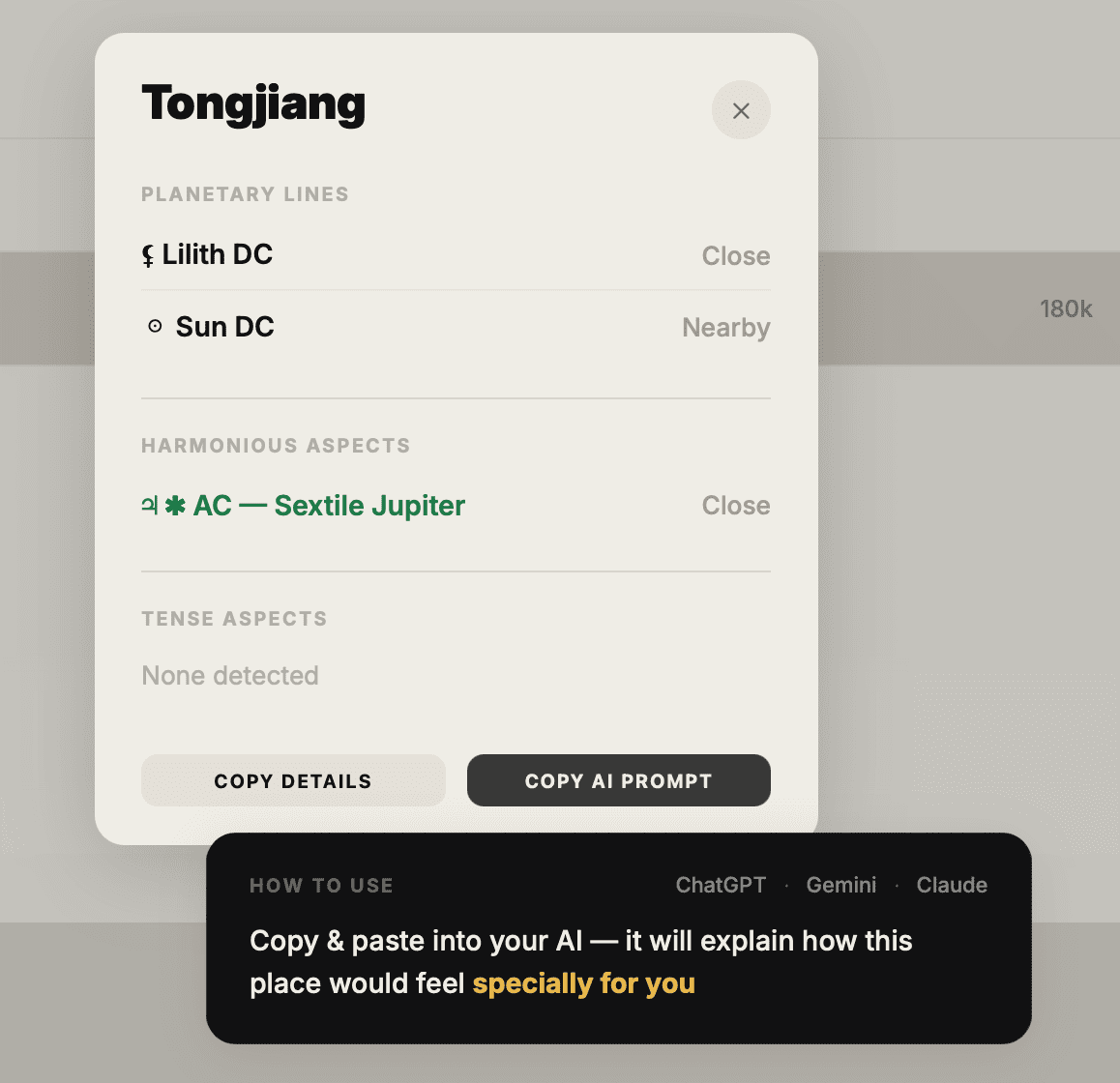
Close-up of a NatalPass city card showing Close and Nearby distance labels with a Copy AI Prompt button
Every distance label — and the aspects behind it — feeds straight into the Copy AI Prompt button.

Measuring Your Map Is Fun for About an Hour

Here's the honest truth nobody really tells you before you dive in: manually measuring distances between your lines, aspects, and a shortlist of cities is genuinely fun for the first thirty minutes — maybe even the first hour.

It feels productive. It feels like detective work. You zoom in, check the scale, open another tab, compare cities, and get that satisfying "I'm figuring this out" feeling.

But somewhere around hour two or three, it quietly stops being fun and starts becoming exhausting. You're cross-referencing distances, trying to remember which aspects you already checked, opening tab after tab, second-guessing yourself, and still not completely sure whether the city you like best is actually clean or if there's a tense aspect you might have missed.

This is precisely the moment NatalPass was built for.

Instead of spending hours doing manual detective work, you can get the clearest, purest results in seconds. The platform handles the complex layering so you don't have to. Your time and energy can go where they truly belong — toward imagining your life in new places, listening to your intuition, and making decisions that feel right, rather than measuring maps with a ruler.

FAQ: Distance and Orb in Astrocartography

How close do I need to be to feel an astrocartography line?

Generally, you'll feel the influence strongly within about 100 km. Between 100–200 km it's still meaningfully present, but softer and gentler. Beyond 200 km, the exact line's effect usually becomes too faint to base important decisions on.

What is an orb in astrocartography?

An orb is simply the margin of distance around an exact line or aspect where its influence is still considered active. It explains why you don't need to live precisely on a line to feel its energy — the effect fades gradually rather than turning off suddenly.

Is 200 km too far from a planetary line?

It's right at the practical edge. You might still notice something, but the energy is significantly weaker than when you're closer. For most people, 200 km is the point where the exact line stops being a major factor in choosing a place.

How far should I stay from a tense aspect?

It's wise to give yourself more space than when seeking a harmonious one. Staying more than 200 km clear is a safer practical buffer, because tense aspects can sometimes be felt faintly even a bit further out than harmonious ones.

Does the same distance rule apply to lines and aspects?

Not exactly. Exact planetary lines tend to stay strong out to around 200 km. Aspects are more diffuse and usually fade faster — they're most meaningful within about 100 km, except when you're actively trying to avoid a tense one.

Does NatalPass calculate distances for me?

Yes — and this is one of the biggest time-savers. Every line and aspect near a city is already sorted into a clear, easy-to-understand category: Direct Hit, Close, Nearby, or Somewhat. You never have to measure anything manually.

What's the fastest way to avoid tense aspects?

Use the "Remove Tense Near" filter on NatalPass. It works across Line Search, Aspect Search, and Country Search. With one click, your results narrow to places that are genuinely clearer of nearby friction.

Is there one universally agreed orb distance in astrocartography?

No. Astrologers have different opinions — some traditional sources use very wide orbs (up to 700 miles), while most contemporary practitioners work with much tighter, practical ranges. Treat any specific number, including the ones here, as a helpful guideline rather than a strict rule. Your own sensitivity and experience will always be the final guide.